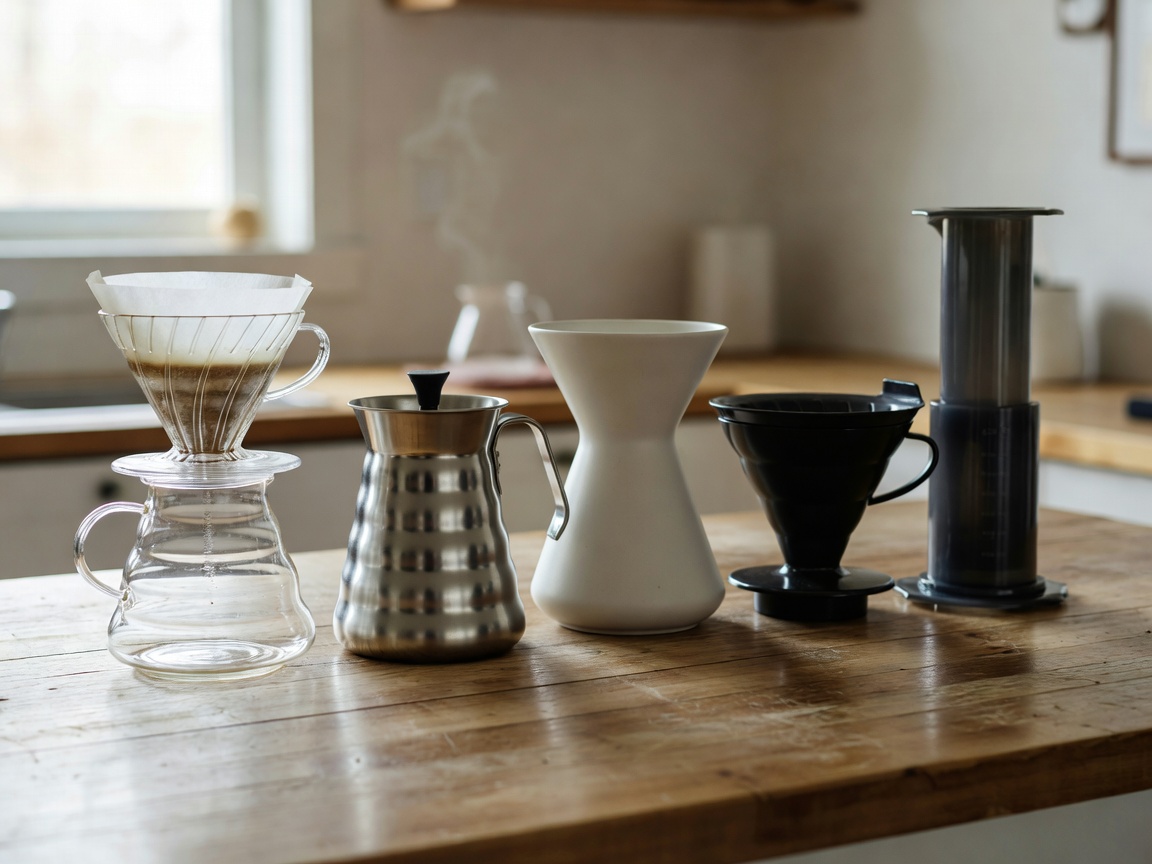
While espresso represents coffee at its most concentrated and intense, filter brewing approaches the bean from a gentler angle. By elongating the extraction time and utilizing paper, metal, or cloth filters, manual brewing methods yield a beverage that highlights delicate floral notes, bright acidity, and complex tea-like bodies that pressure brewing often obscures.
Pour-Over Dynamics
The pour-over is the cornerstone of the modern specialty coffee "slow bar." Devices like the Hario V60 or the Kalita Wave rely on percolation—water passing continuously through a bed of coffee grounds. Because fresh water is constantly introduced, the extraction efficiency is high, making pour-overs exceptionally articulate in flavor.
Brewing a successful pour-over is a delicate dance of variables:
- The Bloom: When hot water initially hits fresh coffee, carbon dioxide trapped during the roasting process is released, causing the bed to bubble and swell. Allowing the coffee to "bloom" for 30-45 seconds ensures that this gas doesn't repel water during the main brewing phase.
- Agitation: The kinetic energy generated by the pouring stream stirs the grounds. Too much agitation can cause the filter to clog, leading to astringency; too little can result in dry pockets and under-extraction. Gooseneck kettles are deemed essential for their unparalleled pour control.
- Drawdown Time: The total time it takes for the water to pass through the coffee bed (usually between 2.5 and 4 minutes) acts as an indicator of grind accuracy. A swift drawdown suggests a grind that is too coarse, while a sluggish drip points to grounds that are too fine.
Immersion Techniques
In contrast to percolation, immersion methods involve steeping the coffee grounds fully in water before separating the liquid. Because the water gradually becomes saturated with coffee solubles, the extraction rate slows down naturally. This makes immersion methods exceptionally forgiving and consistent.
The French Press is the classic immersion brewer. Operating with a coarse metal mesh, it allows oils and fine sediment into the final cup, resulting in a rich, weighty mouthfeel ideal for darker, chocolate-forward roasts. However, without a paper filter to trap lipids, the more subtle, acidic notes of lighter roasts can be masked.
The AeroPress represents a hybrid approach. It begins as an immersion steep but finishes with pressurized percolation as the user plunges the water through a dense paper micro-filter. This versatility allows brewers to manipulate variables dramatically, crafting everything from a dense, espresso-like concentrate to a clean, bright, filter-style cup.
Water Quality and Temperature
Since filter coffee is composed of roughly 98% water, the chemical makeup of that water is critical. Water that is too soft lacks the minerals (like magnesium and calcium) necessary to bind with flavorful coffee compounds. Conversely, overly hard water can mute acidity and produce a chalky texture.
Temperature also plays a vital role. Lighter roasted coffees, which are physically denser and more resistant to extraction, generally benefit from hotter water (often directly off the boil, around 98°C or 208°F). Darker roasts, whose cellular structures are more porous from prolonged heat exposure in the roaster, are better suited to lower temperatures (85-90°C) to prevent the extraction of harsh, bitter compounds.